Sunday, January 29, 2012

Collecting Part 1


We all love to collect, but why do we collect? the range of psychological interpretations of this fundamental behaviour is enormous. Baudrillard warns us that the collecting impulse is regressive and escapist. Susan Stewart offers a more gentle approach to say that it is a means of control over our environment.


Philipp Blom in To Have and To Hold: An Intimate History of Collectors and Collecting,  says that the collector’s devotion infuses life into these dead objects, forming a bridge “between our limited world and an infinitely richer one, that of history or art, of charisma or of holiness,” a world, he concludes, “of ultimate authenticity and thus a profoundly romantic utopia.”


My favourite view is that it is the process of collecting that is the thing.. that completeness and closure are impossible… it is a process of continual inquiry and endless desire. The thrill of acquisition and the pleasure of reviewing the collection as a means of remembering the exciting process of the hunt for each thing.


In etsy and on ebay I come across a lot of collectors, and I find them fascinating - so I thought I would start a series of posts about particular people who I have met who are avid collectors.


Bonnie is a customer of mine who collects vintage paua shell embedded in resin.


Paua is regarded by New Zealanders past and present as a taonga or treasure. Maori legend has it that paua was a special gift from Tangaroa, the God of The Sea. It is unique to New Zealand, that lives on the rocky shoreline all around the coast, but grows best in the waters of southern NZ. This marine mollusk eats seaweed and lives clinging to rocks at depths of 1-10 meters, normally along the shoreline. Paua Shell is the most colorful of all the abalone shells. Most other abalone are pale in comparison. 


Here is Bonnie's story


Tell us about your background, why you collect and how it got started


I work in a bookstore in San Francisco, live north of the Golden Gate Bridge in the shadow of Mt. Tamalpais (the sleeping lady). My interest in the paua / koha stuff goes back a long time. As a kid I was a bit of a magpie--always attracted to shiny sparkly things. At some point I was given a small butterfly pin made from silver and abalone and I was hooked. I love our local abalone shell, but find the blue/green hues of the NZ paua shell even more difficult to resist. I've been to NZ twice and just fell in love with the country and her people. There are many parallels between living on the coast in California and being in NZ.


What is the holy grail of your collection? That is, what is it you are keen to get your hands on that you don't have?


You know what I'd really love to have? A catalog of all the items in the koha product line! I know there is one out there someplace in some shopkeepers overstuffed and never cleaned out since the 1970's file cabinet. 


What are the best and worst aspects?


One of the coolest things about collecting has been meeting the people that are acting as my non-local eyes! I've got you and a fellow in Tasmania and others who let me know when they see things I might like.I've been having a blast getting this collection together. I was totally bummed to miss out on a 3 tray collection on ebay (darn outbid notices!), but I'm sure the person who got them will also enjoy them. I'm old enough that I know that if I'm meant to have something it will come to me, and some things are meant for others-- no sense crying over it. Over time I've come to appreciate the value of vintage items, which often have great quality and were made in the country in which they were originally sold. I'm not a fan of cheap plastic stuff, which is really hilarious considering that I'm collecting paua shell bits cast in resin in the 60s and 70s! What can I say-- when my tiny little teardrop trail is done being constructed it's going to have some very sweet koha items in it! :)


So, readers, if you have a passion for collecting a particular thing - please drop me an email and I would love to do a post on you! Come on, don't be shy!


Wednesday, January 25, 2012

Australia Day on January 26 celebrates  the arrival of the  First Fleet carrying convicts at Sydney Cove in 1788. 
On 26 January, early in the morning, British Captain Arthur Phillip along with a few dozen marines, officers and oarsmen, rowed ashore and took possession of the land. He established the first penal colony in Australia.
Today it is a time of coming together and reflecting on being Australian and typically the day is spent celebrating out doors - at barbecues, picnics and on the beach. At the moment however, it is raining which may be a problem!
Never the less for the next 48 hours I am having a sale at my etsy store of 20% off everything. Use code AUSTRALIA2. Happy Oz day.

Saturday, January 7, 2012

See through


                                        http://www.etsy.com/listing/81668529/vintage-pair-of-1960s-italian-clear


In my old job I spent a lot of time looking beneath the surface - I was interested in not how things are presented but what is being hidden. As an artist this continues - there is something much more interesting in what is witheld. It is no surprise that I am hopelessly attracted to transparent and translucent lucite.


Transparent lucite allows you not to see what is being witheld as there is nothing inside - but allows you to see the inner structure and external skin of an object all at once. The existential philosopher Heidegger would call this 'Throwness" meaning that transparency reminds us of actually being that is, we are literally thrown into existing and being aware of this by being able to see the very structure and physicality of things around us. 


Glass has been around since ancient times, and provided us with these philosophical opportunities but with practical limitations. 1839 was the beginning of the plastics era when Charles Goodyear developed a method for processing rubber commercially. The first made man plastic was created by Alexander Parkes who demonstrated it at the 1862 Great International Exhibition in London. In 1907, Leo Hendrik Baekeland invented the first fully synthetic resin to be commercially successful, called bakelite.
Plexiglass or acrylic or lucite is a synthetic polymer and was developed in 1928 in various laboratories. It was first brought to market in 1933 by Rohm and Haas in US under the trademark Plexiglass. As a light shatter resistant alternative to glass, the material was developed and manufactured for aircraft canopies and submarine windshields  in WWII.


It was after World War II that the process of embedding objects in Lucite was developed and it became popular as a cheap material for jewelery making after the war. Innovations such as moonglow and confetti lucite jewelry appeared from 1940s.


In the early 1960s the concept of disposable culture became something to celebrate, and geometric space age fashion by haute couture designers like Cardin and Coureges encouraged PVC dresses and lucite jewelry. The result was an influx in cheap easily mass produced geometric shaped lucite pieces.  Lucite was to re-emerge as a popular material as organic forms in the 1980s and this continues today. There is a real softness and tactility and warmth that adds to its appeal for me.


Monday, December 26, 2011

20% off everything

HAPPY HOLIDAYS AND NEW YEAR EVERYONE
20% off everything at evaelena from 
28th December to 1st January, 2012
use coupon code AUSTRALIA

Tuesday, November 22, 2011

Xmas Sale for Aussies


Australian and NZ Customers only
Use code FREESHIPPING until Nov 30.

Monday, November 21, 2011

Xmas Gift Guide


Mother


Father


Grandma


Grandpa


Big Sister


Little Sister


http://www.etsy.com/listing/66300953/vintage-retro-nova-scotia-lighthouse


http://www.etsy.com/listing/86442386/vintage-retro-1970s-stack-of-brass-and


Little Brother


Big Brother


Hubby/boyfriend


Girlfriends


Boss/Professor


http://cgi.ebay.com.au/ws/eBayISAPI.dll?ViewItem&item=110769086935&ssPageName=STRK:MESE:IT


The Girl or Boy who has Everything


Secret Santa Gifts


Wednesday, November 16, 2011

Dubai visit

I have just spent a very interesting week in Dubai visiting my daughter. Now, I have travelled to various parts of the middle east before, and I know that the souks or markets are terrific places to find interesting old things. It was a surprise to find that the local Emerati community of Dubai seems to be totally subsumed by the consumer needs of their expat population. Traditionalism in arts and crafts or cultural practice are hidden from the tourist gaze. 

What is left is what Baudrillard, the french philosopher would call, a simulacra - an artificial construction - a simulation of the real which in Dubai translates into an arab type disney world on a large scale in the form of resort type living communities, and huge shopping malls which cater for the western taste.


The picture above shows a flea market in downtown Dubai. Set in a beautiful park, it consisted of expats offloading their stuff before returning home and eastern Europeans selling costume jewelery.
I was hoping for something interesting to buy, but there was a lot of ikea and huge piles of modern clothes at bargain prices. You could hardly move for the crowd and this was at 8.30 in the morning!

Shopping malls look and feel like every where else in the world except that there are skiing fields or giant aquariums in them, or history lessons full of life ancient boats and ancient architecture. These add a welcome interest to endless big brand shops. Souks it turned out were also full of contemporary tourist trap stuff. The beautiful bedouin dress below was unusual. The lights although traditional were also new and can be found in Morocco.


I can't complain however about the use of traditional architecture in these contemporary souks, such as in Medinat below. The richness and ornateness of middle eastern art continues to be a fascination. As there was nothing old to buy- I focused on the design elements of this fascinating hybrid city.


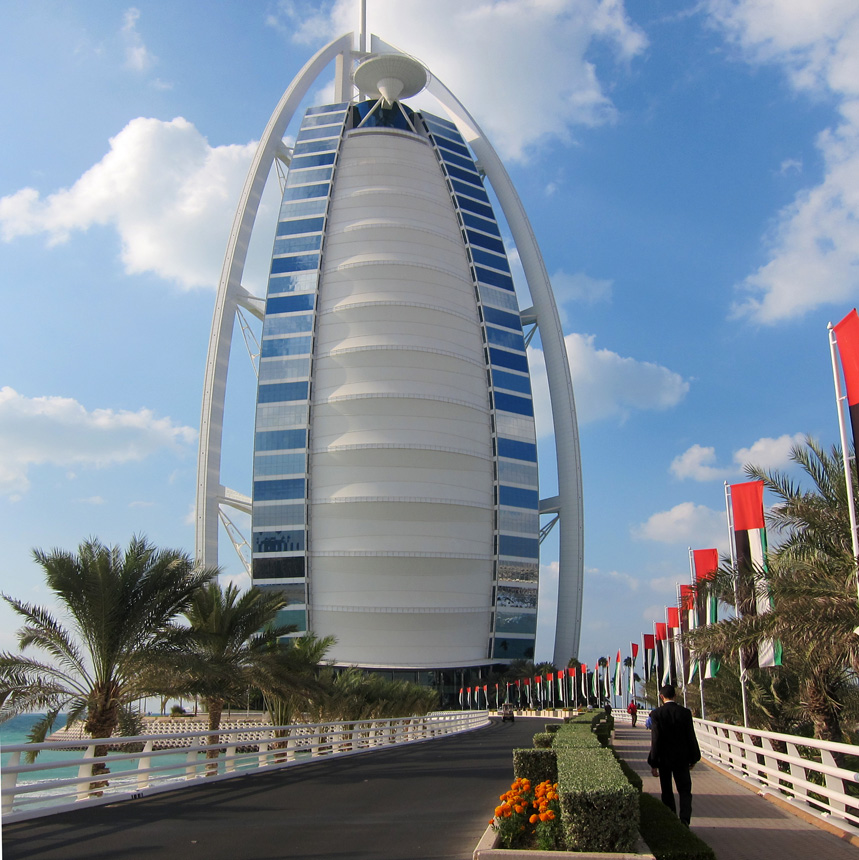
In particular I was taken with some of the interior design of the Burge Al Arab - the famous sail shaped 7 star hotel in Dubai (yes, thats a helicopter pad on top - you can't expect guests to enter by foyer can you?) 


By western standards it has been criticised as kitsch and extravagant and yet it is particularly middle eastern in taste but in a contemporary form. The lift doors for example are pure deco to me - yet on closer inspection they are arabic words and nature inspired shapes and forms that are traditional to the culture and have long been in use as decorative motifs (no doubt influencing the west in the early twentieth century)


The balconies above reference old middle eastern domestic architecture and the colours reflect the surrounding sea and sand of the desert. The gold plated everything that you see above in the foyer (yes, real gold) is an expression of opulence, wealth and power, and it is far less garish and tasteful than the same use of gold at Versaille or Trump Tower for example.

Curiously in the midst of this hyper traditionalism - references to the future in the form of the entrance bay to the restaurant really stand out - It was very unexpected and quite exciting to see walls of circuitry fit so well into this post modernist interior. 


Kitsch by western standards? I don't know - is there anything more kitsch than acres of bland  marble, steel and glass that is supposed to represent class and elegance in the western corporate hotel and shopping mall world? We seem so bland in the west, so lost in what Billy Connolly the comedian calls beigism.


In Dubai, it turns out that there is evidence of continuing traditional craftsmanship everywhere - if you look for it. Give me the energy and individualism and rich iconography of other contemporary cultures every time!