Sunday, March 4, 2012

Collecting part 5


Food and home cooking can be viewed as significant anchors to our identity and sense of belonging as we grow up. As adults, memories associated with childhood experiences of food give us a direct link to those positive emotional attachments and experiences.  This weeks collector, has a passion for the humble corningware dish - a brilliantly designed and functional kitchen item that has figured in many of our pasts and continues to do so today.

The white glass ceramic from stove to table was invented in 1953 and evolved directly from research into materials for ballistic missiles nose cones. Corningware's oven-to-table service first featured the little blue Cornflower decoration, designed by Joseph Baum in Connecticut and continued to be used as a motif for 30 years.


Can you tell me a little about your background? (where do you live, how old you are, background education/interests, work, family etc)

My name is Jessa and I currently reside in the beautiful foothills of California with my wonderful husband, Chris, our pups; Gage & Armani, and our three kitties; Remington, Colt, and Little Girl. I am a full time blogger Confessions of the Cupcake Countessa and online vintage/upcycle shop owner CAKED Clothing. I am 27 years young, the oldest of five children, and the only girl!

What do you collect?

I have a passion for collecting Cornflower Corningware. My collection is currently over thirty pieces strong and growing all the time!


How did you get started?

As a young girl I remember my mother owning her own pieces of this collection. There was always something about the simple beauty of those dainty blue flowers that intrigued me. Now, as a wife and homemaker, I too collect them. They are still as simply beautiful as ever to me.


What attracted you to collecting them, in other words, why?

They always reminded me of love and weddings. It must have something to do with the "something blue" aspect of them. I always loved them and when I started the vintage business I found that I was stumbling across pieces in my search for vintage clothing. Needless to say, I would buy them up where ever I found them and before you knew it I had a little collection on my hands!


What is the holy grail of your collection? That is, what is it you are keen to get your hands on that you don't have?

There are so many pieces I long for but the pieces I truly long for are the counter savers. I have never encountered one but would love to have them to set my darling pieces on! Someday...


What are the best aspects about being a collector?

It's like a constant treasure hunt. Most of my searches involve locating items others will like but it's so nice to keep an eye out for myself. When I do find a piece I can't help but smile!


Do you collect something? I would love to hear about it and feature you in my blog. Please contact me.

Sunday, February 26, 2012

Collecting part 4

So the poor have hope, and injustice shuts its mouth


This is the catch phrase for an organisation in Nepal called L Pida which provides a structure for women rescued from sex trafficking to develop garment making skills and build viable futures for themselves. This weeks collector, Hosanna has a passion for vintage clothes and donates a portion of her proceeds from her etsy shop Carolina Roses to this cause. 


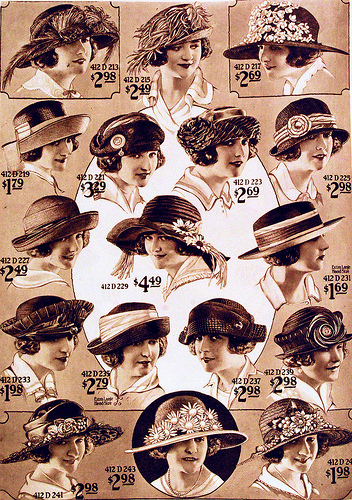
But it is her passion for vintage hats in particular that is the focus of this week's blog. 
Although women from an early stage were always expected to have their heads covered by veils, kerchiefs, hoods, caps and wimples, it was not until the end of the 16th century that women's structured hats, based on those of male courtiers began to be seen.The word 'milliner', which is a maker of women's hats, was first recorded in 1529 when the term referred to the products for which Milan and the northern Italian regions were well known, i.e. ribbons, gloves and straws. The haberdashers who imported these highly popular straws were called 'Millaners' from which the word was eventually derived.


Can you tell me a little about your background? (where do you live, how old you are, background education/interests, work, family etc)


My name is Hosanna. I live on a farm in Virginia, USA, with my husband, dog, five rescued cats, a pet goat, chickens, and 11 horses. I am 31 years old. I work as a home health attendant, sitting with and elderly lady and her challenged granddaughter. In my spare time I have an Etsy shop where I sell vintage clothing and accessories.


What do you collect?


I collect vintage hats. My personal collection is at just over 80 hats right now, from the 30s - 60s, mostly.


How did you get started?


My mother purchased my first vintage hat (from the 40s) as a gift when I was about 17 years old. I fell in love with it, and with hats in general, and started buying them when I found them in thrift shops, etc. I still have that hat my mother bought me. It has a place of honor in my collection.


What attracted you to collecting them, in other words, why?


I collect hats because I find them so beautiful. Velvet, satin, feathers, beads, bows, ribbon, felt, straw, millinery flowers, fur, tulle, veiling, rhinestones.... they're made up of so many beautiful materials. I rarely see two hats alike. Most people don't wear hats anymore, and it is sad to see them cast off and forgotten in thrift shops, rummage sales and the like. To me, they're beautiful bits of fashion history, and I can't resist taking them home with me when I find them.


What is the holy grail of your collection? That is, what is it you are keen to get your hands on that you don't have?


The Holy Grail for me would be some turn of the century hats. Right now my oldest hat is a 1930s Elsa Schiaparelli hat. I'd love to find something from the 1910s era. I am sure I could find many beautiful examples ready to buy on the internet, but part of the "charge" I get out of collecting hats is the "thrill of the hunt", and finding them unexpectedly. So I am going to keep my eyes "peeled" for that Holy Grail.


What are the best aspects about being a collector? 


For me, the best part of collecting is the fun of finding the hats. I love to get up on a Saturday morning, and go to a flea market or and estate sale and search through all the other "stuff" and discover a gem amongst the clutter.


What are the worst?


The worst part about being a collector is storage! I collect other vintage items as well and sometimes I start to feel like a "hoarder" when the collections start piling up. That's part of the reason I started my Etsy shop.  


Do you collect something? Why not share it with us? I would love to hear from you.

Sunday, February 19, 2012

Collecting Part 3


Fellow Australians Adam and Sarah are avid collectors and have a thriving vintage esty store called Hobart Collectibles and I think that choosing which collection to talk about was a challenge for them. I am very pleased they chose something that has a particular resonance with my own childhood. They collect Little Golden Books which were first published in October 1942 and over a billion and a half have been sold worldwide since then.. 


Can you tell me a little about your background? (where do you live, how old you are, background education/interests, work, family etc)

We're Sarah and Adam (speaking) and we live in a three bedroom house in Hobart, Tasmania, with our two and a half year old daughter Israel and her friend Circus, a small black kitten. Between the four of us, we run Hobart Collectables - an antique and vintage collectibles store on Etsy, with some of us putting more input into it than others (Israel and Circus for example don't help at all!).

We essentially both have degrees in Fine Art; Sarah in Drawing and Graphic Design and myself in painting, although in the years up to meeting Sarah in an op-shop I was working in an animal conservation centre in Cambodia, whilst Sarah was busy at Hobart City Mission, both manning their second hand bookshop and doing their graphics.

After buying a whole stack of second hand books and making small talk with Sarah at the front desk, I finally managed to get myself a date with her and thus Israel came into being.

What do you collect?


My first collection, obviously then, would be second hand books (mainly Solzhenitsyn, so I appeared more intelligent), but once we settled down and I could reveal my true tackiness, I dusted off my collection of Biggles books and Sarah began collecting Holly Hobbie.

What we'd like to focus on here though is a totally seperate collection that we started for Israel, which is Little Golden Books (LGBs).


How did you get started?

When both Sarah and I were young, we had the few basic staples such as The Poky Little Puppy, The Saggy Baggy Elephant, Sailor Dog, The Little Red Hen etc., but for our daughter we wanted to go beyond The Classics and introduce her to the entire world of Golden Books.


So shortly after we first realised Sarah was pregnant, we took a trip to various op-shops and started to seriously buy LGBs, thus spawning a bookcase filled with over 500 volumes and a fair number of read-along LGBs + Records to boot.

Initially we went to the op-shops armed with a basic knowledge of what we already had, but as time went on and the collection grew, we had to organise nights to sit down and photograph each book and load the pictures into my mp3 player so we could check if we already had it (possibly subconsciously spawning the plain background that Hobart Collectables is so easily identified by!). 


What attracted you to collecting them, in other words, why?

The beautiful thing about collecting LGBs is that there is no 'Holy Grail' as collectors so often face. Each title is unique in its own right and worthy of inclusion, although we obviously get a kick out of coming across an item specifically mentioned in any of the LGB forums or in vintage price guides. Plus, I really love the LGBs copy cats such as Numbat Picture Books, an Australian version with the Golden Spine, but without the black graphics.


What is the holy grail of your collection? That is, what is it you are keen to get your hands on that you don't have?

Our favourite thing about collecting LGBs is that we get to gift our daughter an entire world of stories and imagination, with the odd moral thrown in just for good measure. Hopefully as she grows up LGBs will play a huge part in her life and then perhaps we'll get the find our 'Holy Grail' - that one LGB we missed when she was younger.


What are the best aspects about being a collector? What are the worst?

For now though the happiness of seeing her face light up whilst we read her a new story is all the reward we need!


Do you collect something? Why not share it with us? I would love to hear from you.

Friday, February 10, 2012

Collecting Part 2


Frozen Charlotte collector, Teresa has a passion for the working with and collecting vintage. Her etsy shop is a treasure trove of goodies called GloryBDesign  


Frozen Charlotte is a name used to describe a type of china doll (cast in one piece) made between 1850 and 1920. It is usually made in the form of a standing, naked figure says Wikipaedia. The name comes from the rather unsettling folk story of a little girl called Charlotte. Here is her story:


Tell us about your background, why you collect and how it got started


I'm Teresa and I live on three acres of woods with my sweet husband, Matt and our three kitties (KiKi, Bunny & Moustache). Other than these kitties that have adopted us, we are "empty nesters". Although, since Matt and I are both completely sentimental, our nest is well feathered with all the things we love to collect! Matt is classic car lover and collects '57 Chevy's, and most recently our 1941 Flxible Clipper bus. He's still working to convince me it will our "traveling retirement condo", but I have to admit, it is pretty awesome! And after another 15 years or so of conversion work, it should be fantastic!

I tend to collect much smaller things - vintage mixing bowls and pitchers, stamps, and my favorite - Frozen Charlottes! Frozen Charlottes (or Charlies, as they are known if they're boys) are small bisque dolls from the 1920's and 30's. They range in height from 1" to 6" or so. They're known as Frozen Charlottes because they do not have any moving parts - they're like miniature figurines. Their arms and legs are molded, without joints. The name comes from a legend that a Victorian girl named Charlotte was invited to go to a party with her handsome beau. The weather was frightfully cold, but Charlotte didn't want to wear a coat because it would hide her beautiful party dress. Alas, poor Charlotte froze to death during the sleigh ride to the party!


I've always had a thing for miniatures. I first discovered the little charmers when I came across one at an estate sale. I was drawn to it because it bore a striking resemblance to a photo I had seen of my mother when she was a little girl. I showed her to my friend, who's an avid doll collector, and she told me what she was. The idea that these are the types of dolls my mom likely played with when she was small, made Charlottes even more attractive to me - did I mention that I'm completely sentimental? All the Charlottes and Charlies have the sweetest little faces, and I have a hard time resisting buying any one that I happen upon!


What is the holy grail of your collection? That is, what is it you are keen to get your hands on that you don't have?

I currently have 76 in my collection. I've been lucky enough to find a couple of sets in their original packaging. One set was sold as "All Nations Dolls" and they feature a girl and boy in their native clothing - A Spanish matador and a senorita, a Native American boy and girl, a Dutch boy and girl, and an Asian boy and girl. I also have two sets of the larger dolls that were originally wedding cake toppers - there's a groom in his tuxedo and his bride. Almost every doll is holding something - a puppy, a hat, a school book, a toy boat.


The most unusual Charlotte I have, has a child's body and a cat's head. I've never seen another like it. I'm always on the lookout for ones that I don't have. I missed an opportunity to purchase a Charlie holding an envelope with a red heart on the seal. I really wanted that one because my dad is a retired mailman, and if I ever find it again, you can bet, I'll be willing to pay up to get it (it's that sentimental thing, again!)


I've given a few away as gifts to dear friends. The rest I have all together on a vintage wall shelf. They always draw comments when folks see them. Most aren't familiar with Charlottes and are amazed at the detail and the absolute cute
ness of the little darlings. The idea of giving small children items made of bisque to play with seems pretty amazing! But it was common practice in the Victorian era and into the early part of the 20th Century.


What are the best and worst aspects?

To me, the only bad part about being a collector is finding space to display your collection without your home starting to look a mess! I don't like to collect things that have to be packed away! To me, the whole point is to be able to admire my collection and share it with others. At least with the Charlottes, they don't take up a lot of space! I think I can squeeze another 30 or so on my vintage shelf!


Do you collect something? Why not share it with us? I would love to hear from you.

Sunday, January 29, 2012

Collecting Part 1


We all love to collect, but why do we collect? the range of psychological interpretations of this fundamental behaviour is enormous. Baudrillard warns us that the collecting impulse is regressive and escapist. Susan Stewart offers a more gentle approach to say that it is a means of control over our environment.


Philipp Blom in To Have and To Hold: An Intimate History of Collectors and Collecting,  says that the collector’s devotion infuses life into these dead objects, forming a bridge “between our limited world and an infinitely richer one, that of history or art, of charisma or of holiness,” a world, he concludes, “of ultimate authenticity and thus a profoundly romantic utopia.”


My favourite view is that it is the process of collecting that is the thing.. that completeness and closure are impossible… it is a process of continual inquiry and endless desire. The thrill of acquisition and the pleasure of reviewing the collection as a means of remembering the exciting process of the hunt for each thing.


In etsy and on ebay I come across a lot of collectors, and I find them fascinating - so I thought I would start a series of posts about particular people who I have met who are avid collectors.


Bonnie is a customer of mine who collects vintage paua shell embedded in resin.


Paua is regarded by New Zealanders past and present as a taonga or treasure. Maori legend has it that paua was a special gift from Tangaroa, the God of The Sea. It is unique to New Zealand, that lives on the rocky shoreline all around the coast, but grows best in the waters of southern NZ. This marine mollusk eats seaweed and lives clinging to rocks at depths of 1-10 meters, normally along the shoreline. Paua Shell is the most colorful of all the abalone shells. Most other abalone are pale in comparison. 


Here is Bonnie's story


Tell us about your background, why you collect and how it got started


I work in a bookstore in San Francisco, live north of the Golden Gate Bridge in the shadow of Mt. Tamalpais (the sleeping lady). My interest in the paua / koha stuff goes back a long time. As a kid I was a bit of a magpie--always attracted to shiny sparkly things. At some point I was given a small butterfly pin made from silver and abalone and I was hooked. I love our local abalone shell, but find the blue/green hues of the NZ paua shell even more difficult to resist. I've been to NZ twice and just fell in love with the country and her people. There are many parallels between living on the coast in California and being in NZ.


What is the holy grail of your collection? That is, what is it you are keen to get your hands on that you don't have?


You know what I'd really love to have? A catalog of all the items in the koha product line! I know there is one out there someplace in some shopkeepers overstuffed and never cleaned out since the 1970's file cabinet. 


What are the best and worst aspects?


One of the coolest things about collecting has been meeting the people that are acting as my non-local eyes! I've got you and a fellow in Tasmania and others who let me know when they see things I might like.I've been having a blast getting this collection together. I was totally bummed to miss out on a 3 tray collection on ebay (darn outbid notices!), but I'm sure the person who got them will also enjoy them. I'm old enough that I know that if I'm meant to have something it will come to me, and some things are meant for others-- no sense crying over it. Over time I've come to appreciate the value of vintage items, which often have great quality and were made in the country in which they were originally sold. I'm not a fan of cheap plastic stuff, which is really hilarious considering that I'm collecting paua shell bits cast in resin in the 60s and 70s! What can I say-- when my tiny little teardrop trail is done being constructed it's going to have some very sweet koha items in it! :)


So, readers, if you have a passion for collecting a particular thing - please drop me an email and I would love to do a post on you! Come on, don't be shy!


Wednesday, January 25, 2012

Australia Day on January 26 celebrates  the arrival of the  First Fleet carrying convicts at Sydney Cove in 1788. 
On 26 January, early in the morning, British Captain Arthur Phillip along with a few dozen marines, officers and oarsmen, rowed ashore and took possession of the land. He established the first penal colony in Australia.
Today it is a time of coming together and reflecting on being Australian and typically the day is spent celebrating out doors - at barbecues, picnics and on the beach. At the moment however, it is raining which may be a problem!
Never the less for the next 48 hours I am having a sale at my etsy store of 20% off everything. Use code AUSTRALIA2. Happy Oz day.

Saturday, January 7, 2012

See through


                                        http://www.etsy.com/listing/81668529/vintage-pair-of-1960s-italian-clear


In my old job I spent a lot of time looking beneath the surface - I was interested in not how things are presented but what is being hidden. As an artist this continues - there is something much more interesting in what is witheld. It is no surprise that I am hopelessly attracted to transparent and translucent lucite.


Transparent lucite allows you not to see what is being witheld as there is nothing inside - but allows you to see the inner structure and external skin of an object all at once. The existential philosopher Heidegger would call this 'Throwness" meaning that transparency reminds us of actually being that is, we are literally thrown into existing and being aware of this by being able to see the very structure and physicality of things around us. 


Glass has been around since ancient times, and provided us with these philosophical opportunities but with practical limitations. 1839 was the beginning of the plastics era when Charles Goodyear developed a method for processing rubber commercially. The first made man plastic was created by Alexander Parkes who demonstrated it at the 1862 Great International Exhibition in London. In 1907, Leo Hendrik Baekeland invented the first fully synthetic resin to be commercially successful, called bakelite.
Plexiglass or acrylic or lucite is a synthetic polymer and was developed in 1928 in various laboratories. It was first brought to market in 1933 by Rohm and Haas in US under the trademark Plexiglass. As a light shatter resistant alternative to glass, the material was developed and manufactured for aircraft canopies and submarine windshields  in WWII.


It was after World War II that the process of embedding objects in Lucite was developed and it became popular as a cheap material for jewelery making after the war. Innovations such as moonglow and confetti lucite jewelry appeared from 1940s.


In the early 1960s the concept of disposable culture became something to celebrate, and geometric space age fashion by haute couture designers like Cardin and Coureges encouraged PVC dresses and lucite jewelry. The result was an influx in cheap easily mass produced geometric shaped lucite pieces.  Lucite was to re-emerge as a popular material as organic forms in the 1980s and this continues today. There is a real softness and tactility and warmth that adds to its appeal for me.